
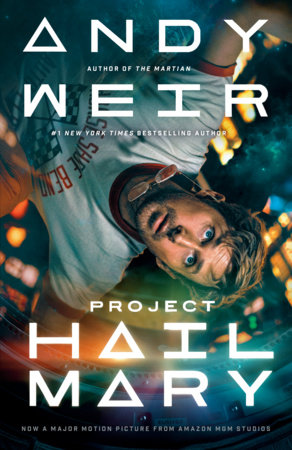
Title: «Project Hail Mary«
Author: Andy Weir
Pages: 482
Edition: 1st
Publisher: Penguin Random House
Genre: Science Fiction
Date: 2021
Language: English
Format: EPUB
ISBN: 978-0593135211
I saw advertisements for the movie at the beginning of March. That was when I decided to buy the book and see how well it had been adapted. I read many comments and reviews describing Project Hail Mary as hard science fiction. What exactly does that mean? I also came across terms such as hard science and hard engineering. What could be «harder» than science and engineering themselves? I can assure you that whoever wrote that was neither an engineer nor a scientist.
After finishing the book, my impression was not that I had read a novel about astrophysics. Rather, I had read a novel about engineering—not as a profession, but as a way of thinking, and there is an important distinction. One can memorise Newton’s laws, solve differential equations or derive Maxwell’s equations and still be a poor engineer. Conversely, an engineer often spends far less time applying formulas than identifying assumptions, questioning observations, designing experiments and deciding which unknown deserves to be reduced first. That, to me, is what Project Hail Mary is really about.
Andy Weir has become known for taking scientific rigour seriously. The Martian established that reputation years ago, and this novel follows the same philosophy. Science is not sprinkled over the story to make it sound believable; science drives the story. Every major obstacle exists because the universe is indifferent to human wishes, and every solution emerges from understanding that universe a little better. Ironically, this is also the reason why some readers dislike the novel.
I’ve seen comments arguing that there is «too much science.» I wonder whether that criticism misses the point. Complaining that Project Hail Mary contains too much engineering feels somewhat like complaining that a detective novel contains too much investigation. Remove the technical reasoning, and very little of the novel would remain.
The book is frequently described as optimistic, and I think that observation deserves attention. Much of contemporary science fiction seems convinced that humanity’s greatest enemy is humanity itself. Governments become authoritarian, corporations become omnipotent, artificial intelligence becomes malevolent, or society simply collapses under its own contradictions. Weir chooses a different route: nature is difficult enough.
That decision changes the tone of the entire novel. Instead of asking whether people will betray each other, the story repeatedly asks a more interesting question: given an apparently impossible problem, what can competent people accomplish if they insist on understanding it? Perhaps that explains why the novel resonated with me more than many recent works of science fiction.
As an informatician, my professional career has followed a different path, but I do not feel entirely detached from science. Software engineering teaches an uncomfortable lesson early on: the first explanation is usually wrong. The first architecture is rarely the final one. The first hypothesis seldom survives contact with reality. Progress comes not from having perfect ideas, but from identifying flawed ones quickly enough to replace them with better alternatives. The same pattern appears throughout Project Hail Mary:
- Observe.
- Form a hypothesis.
- Test it.
- Accept being wrong.
- Repeat.
That iterative loop feels remarkably authentic. It resembles scientific work far more than the familiar cinematic trope of the brilliant genius who instantly discovers the correct answer after staring thoughtfully at a whiteboard.
Of course, the novel is not perfect. There are moments when the explanations become longer than they strictly need to be. Readers primarily interested in interpersonal drama may find those passages excessive. Personally, I never felt they interrupted the story because, in this case, they are the story. Whether that works for a particular reader probably depends less on their knowledge of physics than on whether they enjoy watching someone solve problems methodically. That said, I have to confess that the concept of «astrophage» struck me as rather ridiculous.
If I had to summarise the novel in one sentence, I would not call it a story about saving humanity. I would call it a celebration of disciplined curiosity. That may sound like a subtle distinction, but I think it matters. The real protagonist is not intelligence, luck or even courage. It is the willingness to replace certainty with evidence, to revise one’s own conclusions and to keep moving forward despite incomplete information.
Perhaps that is why Project Hail Mary left me with an unexpectedly familiar feeling. Beneath space travel, exotic biology, and scientific puzzles lies something many engineers experience almost daily: the quiet satisfaction of watching a seemingly impossible problem become, little by little, merely a difficult one. And that, more than any particular scientific concept, is what makes the novel memorable. And, the movie? The movie is good, but as expected, many key moments were either omitted or significantly adapted.
I think it’s worth mentioning the meaning of the book’s title. «Hail Mary» is an American idiom that refers to a last-ditch, desperate attempt to solve a problem when the chances of success are very slim.
And finally, by the way, while I was reading this book, I came across some old records, one of them by Simple Minds. After listening to it again, I found that one song in particular resonates with this book. Check out the lyrics, which are included below the embedded video.
So where did you go?
Where do you go in the Big Sleep
Going out in the Deep Sleep
Is where you’re wandering now
So where did you go
When you’re in the Big Sleep
Drifting in wildlife
And still you’re wandering nowWe were on the top and the world was spinning
We were only young in the whirlpool of warning
Communication lost in the thundering rain style
A shelter from the storm in the early beginning
Going out in the Big Sleep, out in the Big Sleep
Could have been years, you know it could have been years
Or only seconds agoBig Sleep, Deep Sleep
Where are you now?
Now that you’re up in Big Sleep
Valuable friend
They saw you leaving this wayWe were on the top and the world was spinning
We were only young in the whirlpool of warning
Communication lost in the thundering rain style
A shelter from the storm in the early beginning
Where did you go?
Immaculate friend
For a lifetime I’m grateful
And it’s only seconds awayBig Sleep, Deep Sleep
For evermore
If only you could see me
If only you could see me
If only you could see
Forever
Coming home in the Big Sleep
Coming home


