
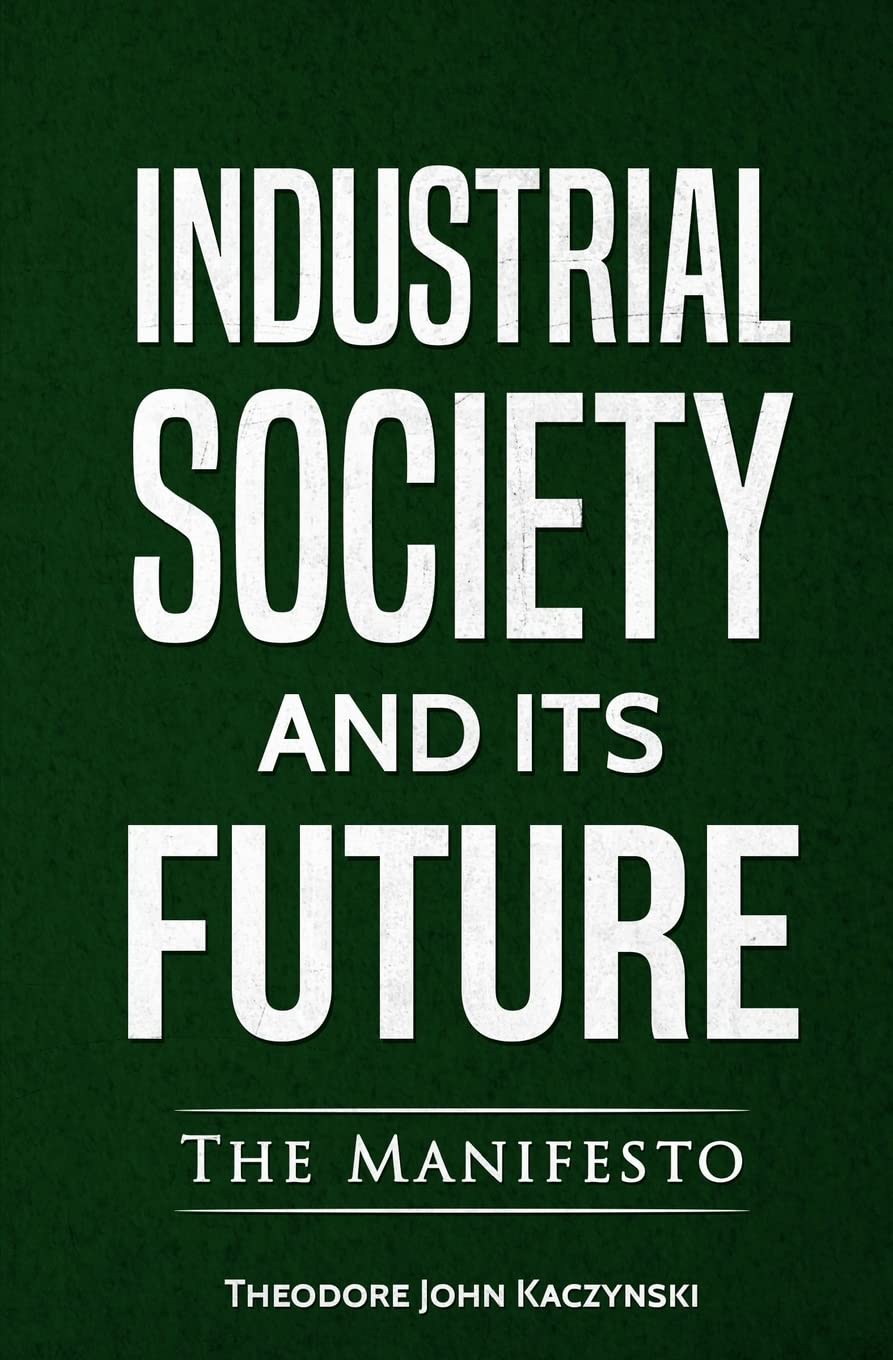
Title: «Industrial Society and Its Future«
Author: Ted Kaczynski
Pages: 58
Edition: 1st
Publisher: Pub House Books
Genre: Political
Date: 2018
Language: English
Format: PDF
ISBN: 978-0994790149
URL: https://web.cs.ucdavis.edu/~rogaway/classes/188/materials/Industrial%20Society%20and%20Its%20Future.pdf
This is the text of a 35,000-word manifesto, submitted to The Washington Post and The New York Times by the serial mail bomber known as the «Unabomber.» It was published under the pseudonym FC, for Freedom Club. This essay first appeared on September 19, 1995. The version I read was based on the one found at http://editions-hache.com/, which has corrected several typos and adjusted some of the typesetting.
The manifesto appeared in The Washington Post as an eight-page supplement and was not part of the news sections. The text was sent in June, 1995 to The New York Times and The Washington Post by the person who calls himself “FC,” identified by the FBI as the Unabomber, whom authorities have implicated in three murders and 16 bombings. The author threatened to send a bomb to an unspecified destination “with intent to kill” unless one of the newspapers published this manuscript. The Attorney General and the Director of the FBI recommended publication. All paragraphs were numbered, and I’m using those numbers to reference them.
My first impression is that this text was written to be deliberately provocative. Also, I suspect a second intention was to be rhetorically effective and maybe a third to aspire to intellectual influence. The truth is that the text is highly reductionist and ultimately built on a series of questionable assumptions. It was written as a manifesto, not as an academic essay, and we can see that, from the very first paragraph, the author does not attempt neutrality, seeking persuasion rather than balanced analysis.
It is impossible to deny that some criticisms resonate with concerns many people still have today:
- Technological progress does not automatically produce happiness.
- Economic growth can coexist with loneliness, alienation, and psychological distress.
- Large institutions can reduce individual autonomy.
- Humans often struggle to adapt to rapid technological and social change.
Unfortunately, it relies heavily on a romanticised view of pre-industrial life, and a major weakness appears almost immediately: the author emphasises loss of autonomy, psychological suffering, and social disruption of modern society but largely ignores the realities that industrialisation reduced: extreme poverty, famine, infant mortality, infectious disease, physical labour intensity, and short life expectancy. Yes, I know some people will argue that these problems persist, but let me continue.
It presents a false dilemma in paragraphs 2–4, effectively framing the future as:
- The technological system survives and destroys autonomy.
- The technological system collapses, causing suffering.
- Revolution is therefore necessary.
This is a classic revolutionary argument that omits the possibility that societies can regulate technologies, adapt institutions, reform economic systems, and balance innovation with human well-being.
Since the manifesto was written in 1995, when genetic engineering was a hot topic, I guess it cites genetic engineering as an example of the risks posed by human knowledge and advances. Despite that, it is strikingly relevant to current debates in digital society and technology.
Reading it in 2026, one of the most interesting aspects is how many concerns resemble modern discussions about:
- artificial intelligence,
- algorithmic decision-making,
- surveillance,
- social media,
- automation,
- loss of human agency.
Even people who strongly disagree with the manifesto may recognise questions such as how much autonomy humans should surrender to complex systems. Does technological capability imply technological desirability? Are people adapting to technology, or is technology reshaping people? Those remain legitimate questions.
For those of us who live in Mexico and have seen the arrival of that «leftist movement» that calls itself 4T (for «Fourth Transformation»), we will see many warnings materialise. Placing «leftist movement» in quotation marks was deliberate because the people who used the pretext of leftist demands and vision to gain popular support and rise to power are neither socialists nor communists. They are simply a group of people incapable of achieving advancement through their own merits, who resent the excesses, privileges, or achievements they perceive in others because they do not enjoy them themselves. And, precisely, Kaczynski’s manifesto portrays them very well.
In addition to including the URL of the file I read, I’ve included my copy with the passages I underlined for anyone interested in knowing what resonated with me and what I’ve described.
References
- Ryota Tamura, Masahiro Toda, «Historic Overview of Genetic Engineering Technologies for Human Gene Therapy«, Neurol Med Chir, 60(10):483-491; Tokyo. Published: 2020.10.15; visited: 2026.06.06. URL: https://pmc.ncbi.nlm.nih.gov/articles/PMC7555159/. DOI: 10.2176/nmc.ra.2020-0049.
- «History of genetic engineering«, Wikipedia, web. Visited: 2026.06.06. URL: https://en.wikipedia.org/wiki/History_of_genetic_engineering


