
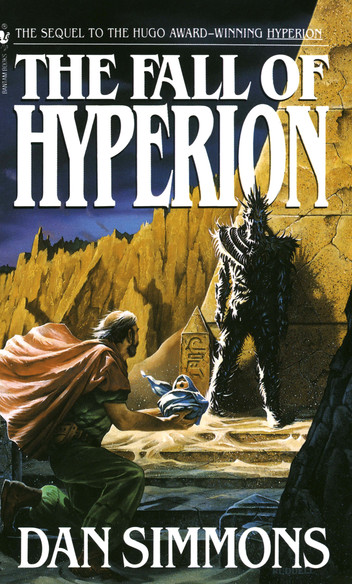
Title: «The Fall of Hyperion«
Author: Dan Simmons
Pages: 1596
Edition: 1st
Publisher: Bantam Books.
Genre: Science fiction (space opera)
Year: 1995
Language: English
Format: EPUB
LC: 89-37438
Ebook ISBN: 978-0307781895
If «Hyperion» was a journey—a pilgrimage filled with stories that blended past, myth, and destiny—then «The Fall of Hyperion» is the culmination of one odyssey that prepares us for another. «The Fall of Hyperion» is, without a doubt, an extremely complex work. It incorporates elements of cyberpunk, time travel, space travel, galactic empires, possible futures, and much more. Also, it confirms what I mentioned in «Hyperion» on Dan Simmons’ admiration for the poet John Keats (and poetry in general).
Despite being expected in the plot, it surprises us with the confrontation of an unknown enemy, a force only hinted at in the first book, but one that no one had imagined until you read and delve deeper into the story with mystery, terror, and fun.
Dan Simmons does not write a «sequel» in the traditional sense of these monumental works, which span several books. It closes the arc begun in «Hyperion«, and it transforms what initially seemed like a series of interconnected stories into a grand science fiction narrative filled with politics, philosophy, and profound questions about humanity (what it means to be human? What could it possibly be for any modern man, a relationship with a god or creator? Could an artificial intelligence be a threat to mankind?). So, if «Hyperion» captivated me with its structure and melancholy, «The Fall of Hyperion» surprised me with its scope: a grander scale, a more tangible danger, an unimaginable cost in exchange for the preservation of the human species, and much more disturbing answers.
While the first book had a «Canterbury Tales» tone (each traveller with their own voice and story), «The Fall of Hyperion» changes pace, placing us at the centre of a war and amid an urgent situation that can only be resolved by several stories taking place at once. Simmons swaps the slow-burning mystery for a narrative where the pieces on the board finally move: the political games of the Hegemony, the ambiguous role of the Technocore, the individual actions of the pilgrims, and the inevitable attraction to the Shrike. The book remains dazzling in its construction: the voice of John Keats as Joseph Severn serves as the guiding thread as we grapple with unsettling questions about power, sacrifice, and the cost of progress.
Both works kept me entertained from beginning to end, but «The Fall of Hyperion» was the perfect sequel and climax to a plot in which all its elements had already been laid out, but in which we couldn’t see how they would play out, as one element had yet to reveal its true face. Without a doubt, a work that could only have been told this way: in several volumes (although, in my opinion, it should have been three, as the confrontation seemed somewhat rushed), in which many questions are answered, but others are left open.

 Dr. Edu